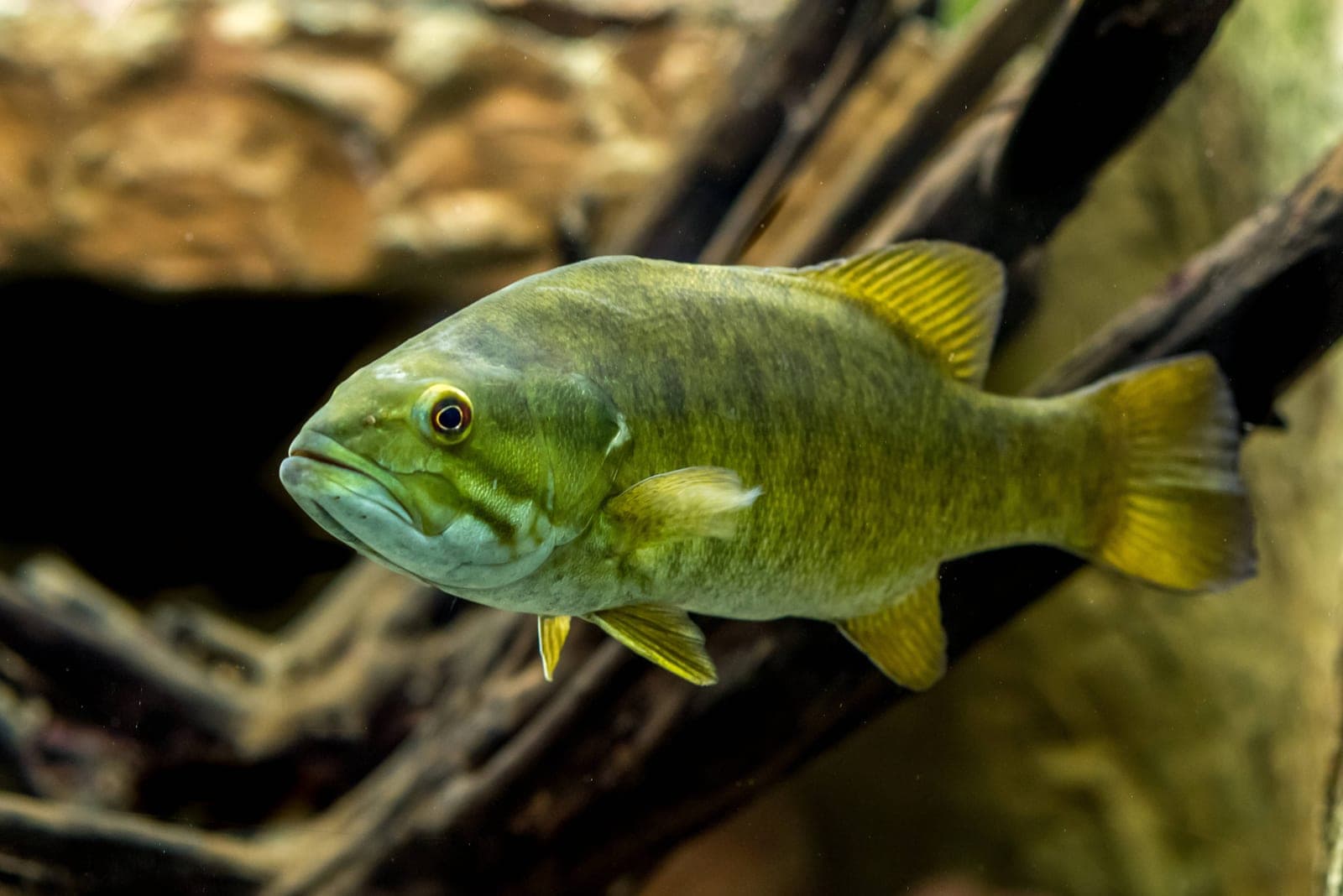
How to know it
A smallmouth is bronze to brown with dark vertical bars down the side and a red or orange eye. Its name is the clue: the jaw, when the mouth is closed, ends below the eye rather than behind it, which is the surest way to tell it from a largemouth, whose jaw reaches past the eye. The two dorsal fins are joined with only a shallow notch between them, where a largemouth's are nearly separated. Young smallmouth carry a tail with three colors — orange, black and white bands.
Where it lives
Smallmouth want clean water, rock and some current. They are the bass of the north: the rocky lakes of northern Wisconsin and Minnesota, the big clear lakes and bays of the Great Lakes, and the rivers — the Mississippi, the St. Croix, the Wisconsin, the Menominee, the Flambeau — where they hold behind boulders and along the edges of riffles. In a lake, look for rock points, boulder fields, gravel flats, islands and the first drop-off; in a river, any current break with a hard bottom.
Through the year
Smallmouth spawn in late spring when the water warms into the sixties, the male fanning a nest on gravel in a few feet of water and guarding it until the fry leave. Many states protect them through this period with a closed season or catch-and-release rules. After the spawn the fish spread along rock and weed edges and feed through early summer on crayfish, minnows and insects. In midsummer on clear lakes they can go deep, holding on humps and rock piles out of sight. Fall brings them back shallow for a feeding period that lasts until the water drops into the forties, when they gather on deep rock for the winter. Few guides target them through the ice.
How guides fish for it
Casting, and often sight fishing. The baits are small and the tackle is light: tube jigs and other soft plastics dragged over rock, small crankbaits and jerkbaits along drop-offs, topwater over flats in the morning, and drop-shot rigs on deep structure in summer. On rivers the trip may be a float, the guide rowing or running between spots while anglers cast to the banks and the breaks. Fly fishing for smallmouth on rivers is its own thing, with poppers and streamers on a 6- or 7-weight rod, and some guides specialize in it. A smallmouth guide knows which rock holds fish at which water temperature, and the day is spent moving to find them.
Handling and release
Smallmouth have no teeth to speak of and are easy to hold by the lower jaw, kept horizontal and never bent back. Most are released. A fish caught from deep water in summer may need a minute at the side of the boat before it swims off.
Rules
Seasons, catch-and-release periods and length limits vary by state and by water — river and lake rules often differ. The Wisconsin DNR and the Minnesota DNR publish the current rules, and a guide will know the ones for the water you are on.
 Driftwell GuidingOut of Cable, WisconsinAllen Lake, Basswood Lake, Chequamegon Bay, Flynn Lake, Lac Courte Oreilles, Middle River, Namekagon Lake, Namekagon River, Turtle Flambeau Flowage