How to know it
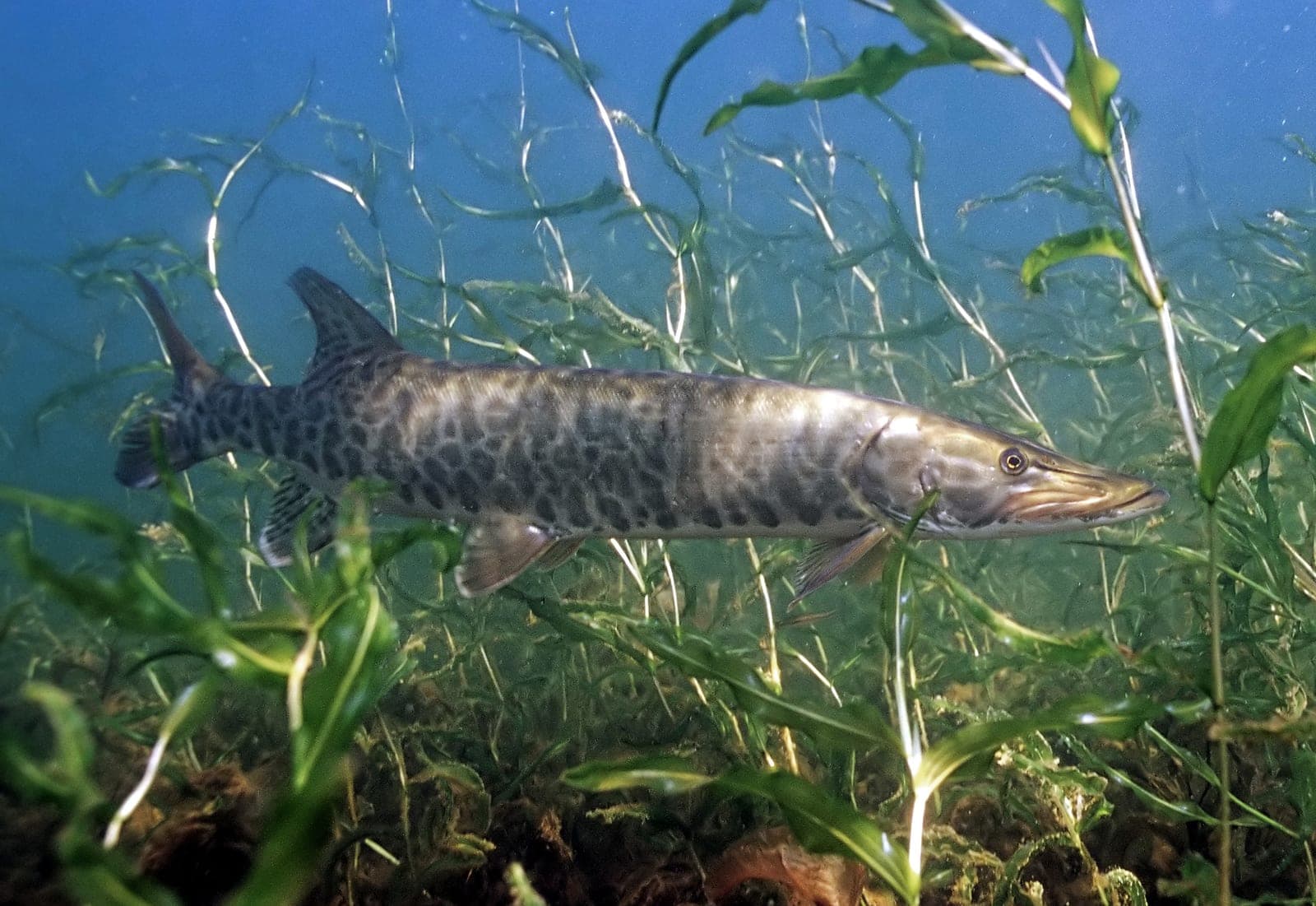
A musky is long, flat-headed and built like a torpedo, with the dorsal fin set far back near the tail so the whole body can snap forward from a standstill. The easy confusion is with northern pike, which share the same shape and often the same water. Three marks settle it. A musky's markings are dark on a light ground — bars, spots or almost nothing at all — where a pike has light bean-shaped spots on a dark ground. A musky's tail fin comes to points; a pike's is rounded. And the underside of the lower jaw has pores: six or more on each side on a musky, five or fewer on a pike. A guide checks the jaw.
Tiger musky, the pike-musky cross, is stocked in some waters and turns up on its own in others. It carries the pike's rounded tail with bold dark bars, and it is usually sterile.
Where it lives
Musky are native to the Upper Midwest, the Great Lakes and the St. Lawrence drainage, and northern Wisconsin and Minnesota hold some of the best natural populations anywhere. They want cover and an edge: weed beds that drop off to deeper water, rock bars, points, the mouths of rivers, downed timber along a shoreline. In rivers they sit in slower water beside current. Lakes with a lot of structure and a lot of forage — ciscoes, suckers, perch — grow the biggest fish.
They are not numerous. A good musky lake holds a few adult fish per acre at most, which is why the fishing is measured in follows and sightings as much as in fish caught.
Through the year
Musky spawn in spring in shallow, marshy bays soon after ice-out, and the states close the season until they are done. Early season fish are in warming shallows and near the spawning bays. As summer settles in they spread to weed edges, rock and open-water structure, and the best bite often moves to low light, moving water or a change in the weather. In fall, as the water cools, the fish feed hard before winter; this is when the heaviest fish are caught, often on the biggest baits, and when a guide is most likely to say the trip is worth the cold. The season stays open on most waters through fall and in some states through the winter.
How guides fish for it
Casting. A musky day is a casting day: hundreds of casts with large bucktails, topwaters, jerkbaits and soft plastics on heavy rods, and a figure-eight at the boat at the end of every retrieve, because a following fish often eats in that last turn. Trolling is the other way, especially in fall and on big open water, with large crankbaits behind the boat. Live suckers under a float are a traditional fall method where the state allows it, and guides who use them rig to release the fish cleanly.
A guide's work on a musky trip is in the boat control, the spots and the pace — knowing which weed edge is holding fish this week, when to switch baits, and when to go back to a fish that followed in the morning. Expect to cast all day and be told, honestly, that one fish is a good day.
Handling and release
Nearly all musky are released, by rule or by habit, and a guide will have the tools ready: a large net the fish can stay in while the hooks come out, long pliers or cutters, and a quick photo at the side of the boat before the fish goes back. Keep the fish in the water as much as you can, support it horizontally if it comes out, and do not hang it by the jaw. In warm water the fish is more fragile and the photo is shorter.
Rules
Minimum lengths, the season and whether a fish can be kept are set by each state and often by each water, and they change. The Wisconsin DNR and the Minnesota DNR publish the current rules, and a guide will know the ones for the water you are on.
 Driftwell GuidingOut of Cable, WisconsinAllen Lake, Basswood Lake, Chequamegon Bay, Flynn Lake, Lac Courte Oreilles, Middle River, Namekagon Lake, Namekagon River, Turtle Flambeau Flowage